Partnership on the Factory Floor: The Rise of Collaborative Robots in Canadian Manufacturing
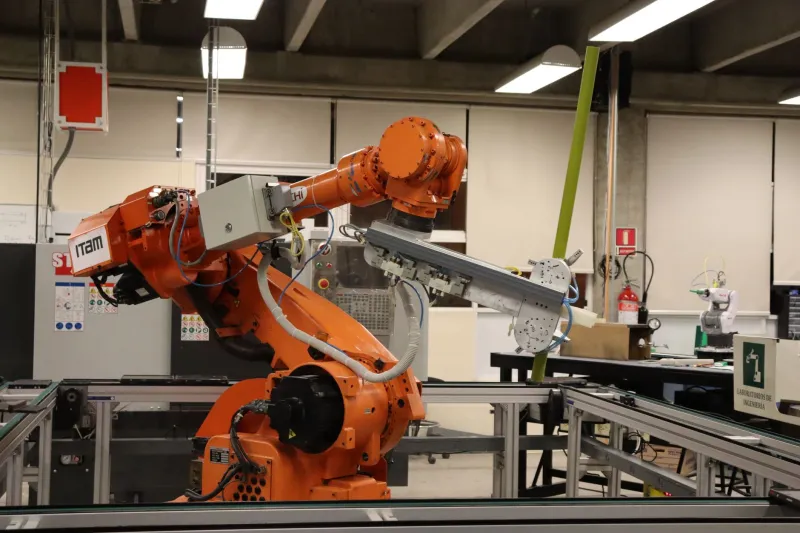
For most of the history of industrial robotics, the relationship between human worker and machine was defined by separation. Heavy robotic systems operated behind guarding, within fenced cells, beyond the reach of anyone without a lockout-tagout procedure and a reason to enter. The robot did its work. The human did theirs. The boundary between them was physical, deliberate, and largely unchallenged.
That boundary is dissolving.
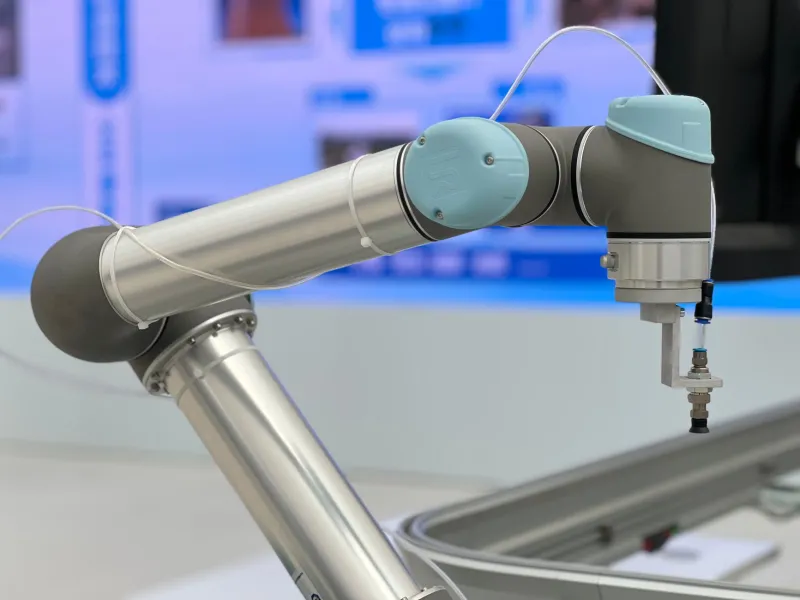
Collaborative robots — cobots, in the industry shorthand — are engineered specifically to share workspace with people. Equipped with force-torque sensors, rounded profiles, and velocity-limiting software, they can detect contact and halt before injury occurs. The result is a fundamentally different kind of automation: not a replacement for the human worker, but a tool that works alongside them, augmenting capability rather than substituting for it.
Across Canadian manufacturing, cobot adoption is accelerating. From precision assembly operations in Ontario's technology-manufacturing belt to fish-processing facilities on the East Coast, the technology is finding application in environments where traditional industrial robots were never viable.
Why Cobots Fit Where Industrial Robots Could Not
The conventional argument for automation has always centred on volume — the economics work when a robot can repeat a task thousands of times without variation. But a significant portion of Canadian manufacturing does not operate at that scale. Small and medium-sized enterprises producing customised components, short-run batches, or products with high mix and low volume have historically sat outside the automation business case.
Cobots change that calculus in several important ways.
First, they are substantially less expensive than traditional industrial robots when total implementation cost is considered. A cobot installation often requires no safety fencing, minimal facility modification, and simplified risk assessment under current ISO/TS 15066 and CSA Z434 standards — the Canadian standard governing industrial robots and robot systems. Second, they are reprogrammable with relatively modest technical expertise, making redeployment between tasks practical rather than cost-prohibitive. Third, their physical footprint is compact, suiting the constrained floor layouts common in older Canadian manufacturing facilities.
The result is a technology whose adoption curve extends well beyond the large-volume, purpose-built production lines that defined the first wave of Canadian industrial automation.
Case Study: Precision Assembly in the Greater Toronto Area
One electronics sub-assembly manufacturer in the Greater Toronto Area integrated a pair of cobots into a manual assembly line producing custom circuit board assemblies. The application — a repetitive but inspection-intensive soldering and component-placement task — had previously been performed entirely by hand, with quality checks conducted by a separate inspector downstream.
The cobot deployment repositioned the human workers rather than displacing them. Operators now load and unload components, perform visual inspection of cobot-placed parts, and handle the exception cases that fall outside the robot's programmed parameters. The cobots handle the high-repetition, ergonomically demanding placement work that had been generating musculoskeletal strain complaints.
Productivity on the line increased by approximately 28 percent over the first six months of operation. More notably, first-pass quality yield improved as well — the cobots' placement consistency eliminated a category of error that had been endemic to the manual process.
"The bigger surprise was how quickly the team accepted it," the facility's operations manager noted. "Once workers understood the robot wasn't going to take their jobs but was going to take the part of their job that was hurting their wrists, the resistance evaporated."
The Safety Standards Landscape in Canada
Operating cobots in compliance with Canadian standards requires a rigorous risk assessment process that goes beyond simply purchasing a robot certified as collaborative by its manufacturer. CSA Z434, Canada's primary standard for industrial robots, requires that the specific application — the combination of robot, tooling, payload, speed, and workspace — be assessed for risk, not merely the robot in isolation.
This distinction matters practically. A cobot operating at low speed, carrying a lightweight gripper, in a defined zone with clear sight lines presents a very different risk profile than the same robot operating at maximum rated payload with a sharp-edged end-of-arm tool. The safety integrity of a cobot deployment is a function of the complete system, not the robot alone.
Canadian manufacturers who have navigated this process successfully tend to engage machine safety specialists early — ideally during the application design phase — rather than treating safety validation as a commissioning afterthought. The investment in proper risk assessment at the outset consistently proves less costly than retrofit guarding or application redesign discovered late in implementation.
The Cultural Dimension
Technical integration is frequently the easier half of the cobot adoption challenge. The cultural dimension — how workers, supervisors, and union representatives relate to the presence of a robot in the immediate workspace — requires deliberate management attention that many manufacturers underestimate.
Facilities that have achieved smooth cobot integration share several common practices. They involve shop-floor workers in the application design process, soliciting input on ergonomics, workflow sequencing, and task allocation. They provide hands-on familiarisation time before production deployment, allowing workers to interact with the cobot in a low-stakes setting. And they communicate clearly about the intent of the technology — what it is designed to accomplish and what it is not.
Where these practices are absent, cobot deployments have encountered resistance that technical performance alone cannot overcome. A robot that workers distrust, work around, or deliberately slow is not delivering its designed value regardless of its specifications.
The Canadian factory floor is not a monolith. Its workers are experienced, often highly skilled, and accustomed to having opinions about how their work is organised. Successful cobot integration respects that reality rather than treating it as an obstacle to be managed.
Looking Ahead
The cobot market in Canada is projected to grow substantially through the remainder of the decade, driven by labour cost pressures, aging workforce demographics, and improving robot capability at declining price points. Applications in welding, material handling, machine tending, and quality inspection are expanding rapidly.
What is becoming clear is that the most consequential decisions in cobot adoption are rarely the technical ones. They are the human ones — how work is redesigned, how workers are engaged, and how the partnership between human capability and machine precision is structured. Manufacturers who get those decisions right are finding that collaborative automation delivers something the earlier generation of industrial robots never promised: a factory floor where people and machines are genuinely better together.